VR Banking is one of the most trusted mobile banking solutions in Germany. It is the official banking app of Volksbanken Raiffeisenbanken, developed by Atruvia AG. The app brings simple, fast, and secure banking to your smartphone. Millions of users rely on it every day to check balances, send money, manage accounts, and track investments with ease.
The idea behind the VR Banking App is simple. Banking should be easy. It should work anywhere. And it should always feel safe.
Let’s break down what VR banking really means, how it works, why banks are adopting it, and how apps like “VR Banking – einfach sicher” show where the future is heading.
What Is VR Banking?
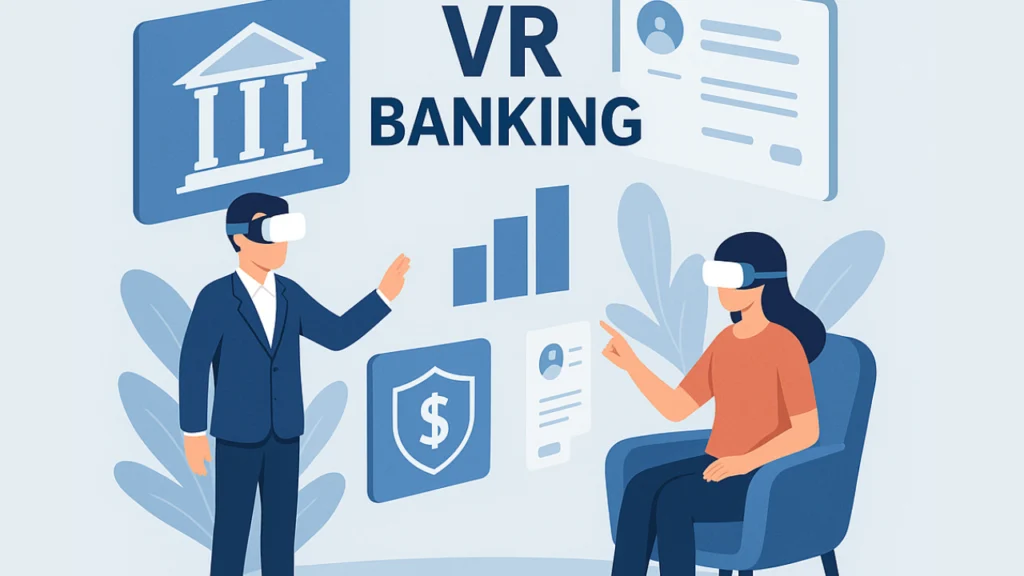
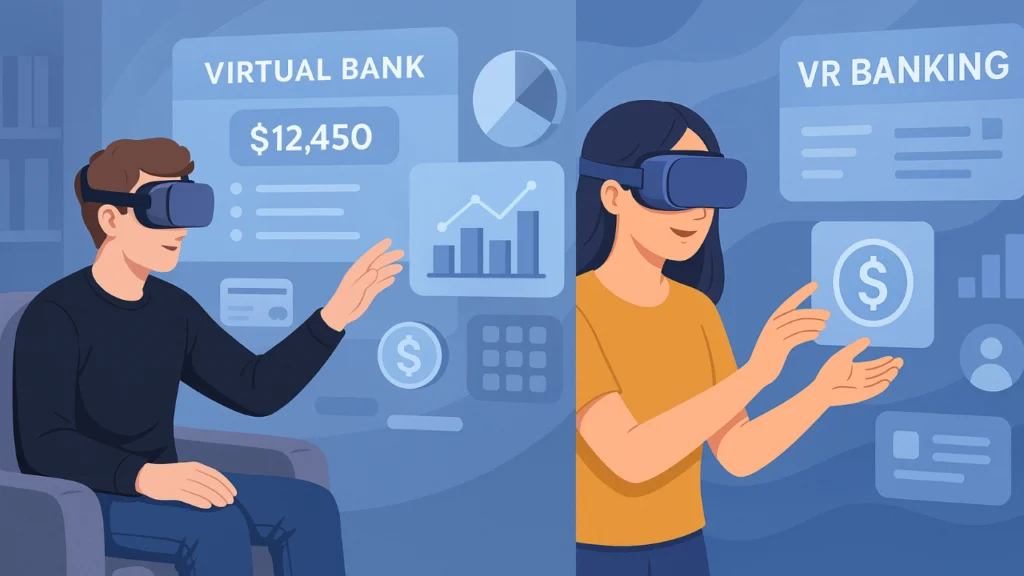
VR banking is a new kind of digital finance experience that lets you manage your money inside a 3D virtual world. Instead of tapping your way through a small screen, you step into a virtual branch, talk to advisors (through avatars), visualize your money in 3D, and explore financial products in a way that feels almost real.
But VR banking isn’t only about headsets.
It also includes VR-inspired mobile apps that offer the same simplicity, security, and convenience as the widely used VR Banking app, with over 5 million downloads.
So VR banking today has two sides:
- Immersive VR experiences 3D virtual branches, virtual onboarding, VR payments
- Advanced mobile banking apps designed with VR-like ease and clarity
Both are shaping the future of how we handle money.
How VR Banking Works
The easiest way to understand VR banking is to imagine this:
You put on a headset
→ You walk into a virtual bank
→ a real advisor (as an avatar) greets you
→ floating dashboards show your accounts
→ You manage everything with gestures and voice.
Behind the scenes, the bank uses secure systems like:
- encrypted VR environments
- VR cybersecurity
- AI-based fraud detection
- virtual ID verification
- and real-time financial engines
It feels like you’re physically present, even though you’re at home.
At the same time, smartphone apps like VR Banking – einfach sicher, updated to version 8.4.0 on October 20, 2025, bring this “immersive” feeling to your phone with:
- simple design
- quick navigation
- fast banking tools
- encrypted mailbox communication
So VR banking is not just futuristic, it’s already in your pocket.
Real-Life Examples of VR Banking
VR-based finance isn’t theoretical anymore. Several global banks and fintech companies are already using it:
BNP Paribas launched a VR app that lets customers enter a digital branch.
Bank of America uses VR for staff training.
JPMorgan opened a virtual lounge in Decentral and is leading the way in metaverse banking.
South Korea’s Kookmin Bank offers VR financial consultations.
Emirates NBD built VR-based wealth management simulations.
Meanwhile, the VR Banking app (By Atruvia AG) shows the everyday side of virtual banking
a clean, intuitive interface that mirrors the future of VR banking, simple, immersive, and human-centered.
Features of the VR Banking App
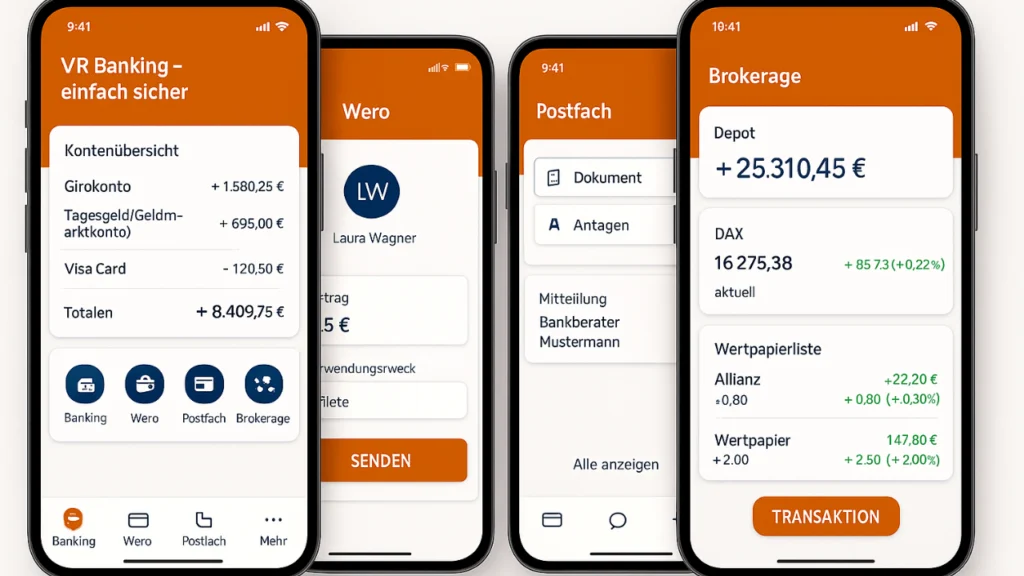
The “VR Banking – einfach sicher” app is one of the clearest examples of where digital banking is heading. It’s designed to feel intuitive, fast, and safe, almost like a simplified version of VR.
Here’s what makes it stand out:
1. All Accounts at a Glance
The app gives you a clean, instant overview of every account’s balances, transactions, and sales.
No searching. No confusion. Everything is right in front of you.
2. Banking Conveniently With Your Smartphone
You can:
- make transfers
- create standing orders
- change or delete standing orders
- manage payments on the go
It feels effortless, almost like interacting in VR is just simpler.
3. Wero Including Kwitt
A super-easy way to send or receive money from friends, family, or contacts.
It’s fast, and it fits naturally into a modern mobile lifestyle.
4. Secure Mailbox
Your account statements and messages from your financial advisor appear directly in the app.
Everything is encrypted in the background, so your communication stays private.
5. Brokerage and Portfolio Management
You get direct access to:
- your securities portfolio
- stock market updates
- brokerage tools for quick action
This is the closest mobile banking gets to a 3D investment dashboard.
6. Photo Transfer
Snap a bill → the app reads it → your transfer form is filled automatically.
A small feature, but it saves time and removes manual errors.
7. TÜV-Tested Security
The VR Banking app is certified and tested for safety, which builds trust — especially important in digital finance.
8. Reliable and Actively Updated
- Version: 8.4.0
- Updated: October 20, 2025
- Downloads: 5,000,000+
- Requires Android: 10 and up
- Released: September 30, 2021
- Developer: Atruvia AG
The ongoing updates show how fast fintech is evolving.
Benefits of VR Banking for Customers
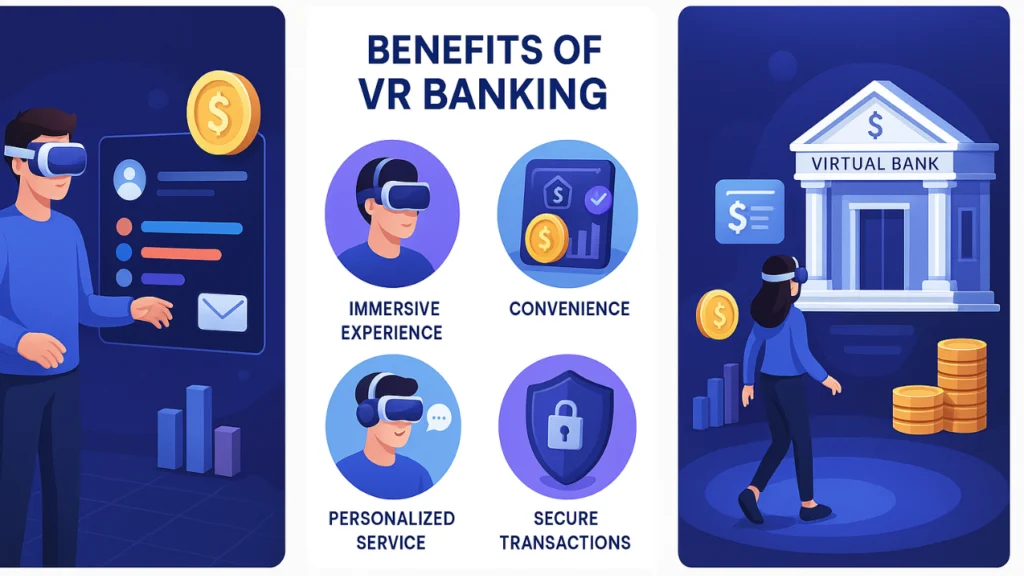
Both VR headsets and modern banking apps offer incredible advantages:
A More Human Digital Experience
You’re no longer clicking buttons; you’re engaging with advisors and your financial world.
Zero Travel, Zero Waiting
You can walk into a digital branch anytime.
Or simply open the VR Banking app and get your work done within seconds.
Better Financial Understanding
Seeing your accounts clearly, whether in VR or a simplified interface, helps you make smarter decisions.
More Confidence in Money Decisions
Interactive VR tools and brokerage features help you act faster and smarter.
Security You Can Trust
With TÜV-tested apps, encrypted VR environments, and biometric verification, safety is built into every step.
How Banks Use VR Today
Banks are using VR to improve:
- Virtual onboarding
- Customer service in VR branches
- VR loan consultations
- Wealth management simulations
- Employee training
- Cybersecurity education
- 3D financial planning tools
Apps like VR Banking represent the bridge between traditional digital banking and the next step, fully immersive VR financial worlds.
VR Banking for Customer Support
Instead of waiting on call centers, VR support lets you:
- sit across from a virtual advisor
- Review your issues in real time.
- Watch floating dashboards showing your accounts.
It feels like walking into a real branch minus the stress.
The VR Banking mobile app also includes a secure mailbox, which lets customers message advisors safely, replacing long emails or confusing calls.
Security, Privacy & VR Risks
Security matters, especially in new technology.
Safety Features
- TÜV-certified systems (like the VR Banking app)
- encrypted communication
- biometric login
- secure mailboxes
- fraud detection powered by AI
Risks to Keep in Mind
- VR devices collect movement data.
- Phishing attempts may evolve into VR spaces.
- privacy-sensitive headset recordings
- unsecured networks during VR sessions
Strong cybersecurity policies are essential for a future of VR finance.
VR Banking vs Traditional Digital Banking
With VR:
You feel inside your finances.
With traditional digital banking:
You tap on screens but don’t feel connected.
VR banking also builds trust by mimicking real human interaction, something apps alone can’t fully do, though modern apps like the VR Banking app are already moving in that direction through simplicity and clarity.
Integrating VR With AI and the Metaverse
AI and VR together create powerful tools:
- AI avatars offering financial advice
- smart VR risk assessment
- personalized financial rooms
- immersive metaverse banks
- VR payments linked to your digital wallet
Picture a world where your finances live inside a 3D environment you can walk through.
That’s where the industry is heading.
Challenges & Limitations
Every big shift comes with hurdles:
- Not everyone owns a VR headset.
- Some people feel dizzy in VR.
- Banks must redesign systems.
- Security guidelines must evolve.
- Hardware costs need to drop.
But remember: mobile banking was slow at first, too.
Now it’s normal.
VR banking will follow the same path.
Future of VR in Finance
Imagine waking up, putting on your VR headset, and stepping into your personal financial room:
Your accounts are floating around you.
Your investments are 3D graphs.
Your advisor’s avatar is waiting with updates.
Your loan simulations are right in front of your eyes.
Mobile apps like the VR Banking app are the training wheels preparing millions of people for this shift. Clean design, fast features, encrypted communication, brokerage access… these are the stepping stones to full VR banking.
Conclusion
VR banking isn’t just a trend.
It’s a new chapter in how we experience money.
The combination of:
- VR banking environments
- AI advisors
- secure mobile apps like the VR Banking app
- 3D financial planning
will shape how we interact with banks for the next decade.
Banks that adopt VR early will build deeper trust.
Customers who embrace it now will enjoy faster, safer, and more personal experiences.
The future of finance isn’t flat.
It’s immersive.
And we’re already stepping into it.
FAQs
What does VR mean in banking?
In banking, VR means Virtual Reality. It refers to using 3D digital environments to offer banking services, such as virtual branches, VR customer support, VR financial planning, and immersive account management. Instead of tapping on a screen, customers can interact with banking services inside a virtual space.
What is bank VR?
Bank VR is the use of virtual reality technology by banks to provide services in a fully immersive environment. You can walk into a 3D virtual bank, meet an advisor through avatars, review your accounts in 3D charts, and complete transactions as if you’re inside a real branch but from home.
Who is eligible for VRS in banks?
The Voluntary Retirement Scheme is meant for bank employees who meet specific conditions.
Eligibility usually includes:
- Permanent employees
- Minimum years of service (often 15–20 years)
- Minimum age criteria (usually around 40 years)
Different banks have slightly different rules, but the idea is to allow employees to retire early with financial benefits.
What are the 4 pillars of banking?
Traditionally, the four pillars of banking are:
- Liquidity – banks must always have money available when customers need it.
- Profitability – banks must earn a steady income to survive.
- Solvency – banks must maintain financial stability and strong capital levels.
- Safety – customer deposits and transactions must always be protected.
These four pillars support the entire banking system.
What are the 4 P’s of banking?
The 4 P’s of banking similar to marketing are:
- Product – loans, accounts, credit cards, investments
- Price – interest rates, fees, charges
- Place – branches, ATMs, mobile apps, VR banking
- Promotion – advertising, campaigns, customer education
Banks use these to design, market, and deliver financial services.
Is virtual banking safe?
Yes, virtual banking is generally safe. Banks use:
- Encrypted communication
- Biometric login
- Secure VR environments
- AI-based fraud detection
- TÜV-tested security (in apps like VR Banking)
- Multi-factor authentication
As long as you use official apps and a secure internet connection, virtual banking is as safe as, or even safer than, traditional banking.
How do I withdraw money from a virtual bank?
Even if your bank is fully virtual, you can still withdraw cash easily:
- Use any ATM connected to your virtual bank’s network.
- Use a debit card provided by the virtual bank.
- Use cardless cash withdrawal options (QR code or app-based)
- Transfer money to another physical bank if needed.
You don’t need a physical branch, just your card or app.
What does the VR stand for?
VR stands for Virtual Reality.
It’s a technology that creates a 3D immersive environment where you can look around, move, and interact as if you’re inside the digital world.
What is a 5% VaR?
A 5% VaR (Value at Risk) is a financial risk measure.
It means:
There is a 5% chance that your investment portfolio could lose more than a certain amount over a given time period.
Example:
If your 1-day VaR at 5% is $10,000
→ There is a 95% chance you will not lose more than $10,000 tomorrow.
→ And a 5% chance you could lose more.
Banks use VaR to understand worst-case risks.
What is the full form of VRR in banking?
VRR stands for Voluntary Retention Route.
It’s a framework introduced by the Reserve Bank of India to encourage long-term investment by foreign portfolio investors in Indian debt markets.
It helps stabilize markets and promote steady capital flows.
What are XR, AR, VR, and MR?
These are different types of immersive technologies:
- XR (Extended Reality):
The umbrella term covering all immersive technologies (AR, VR, MR). - AR (Augmented Reality):
Adds digital elements to the real world.
Example: Pokémon GO or Snapchat filters. - VR (Virtual Reality):
Fully immersive digital environment where everything you see is virtual.
MR (Mixed Reality):
A blend of real and digital objects that interact with each other.
Example: Microsoft HoloLens