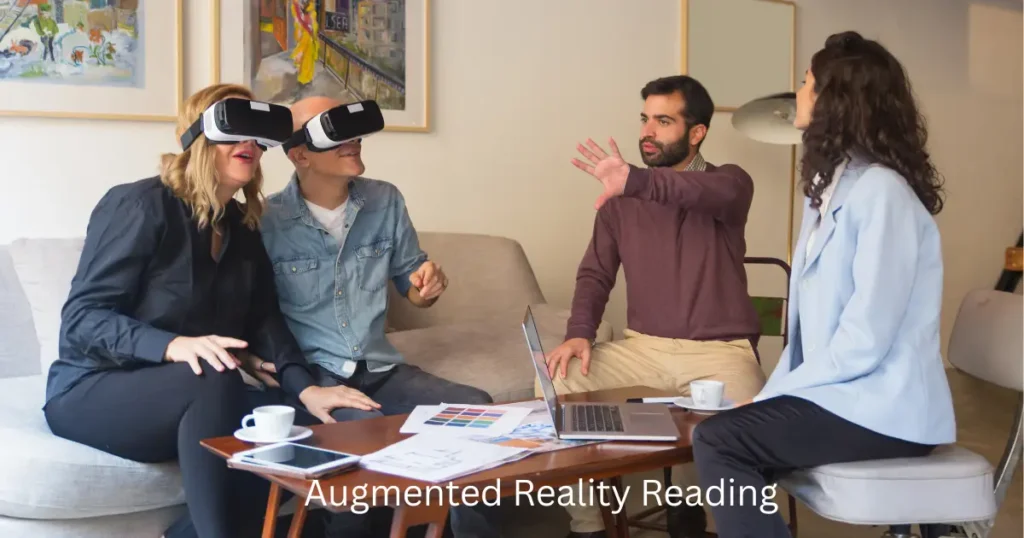
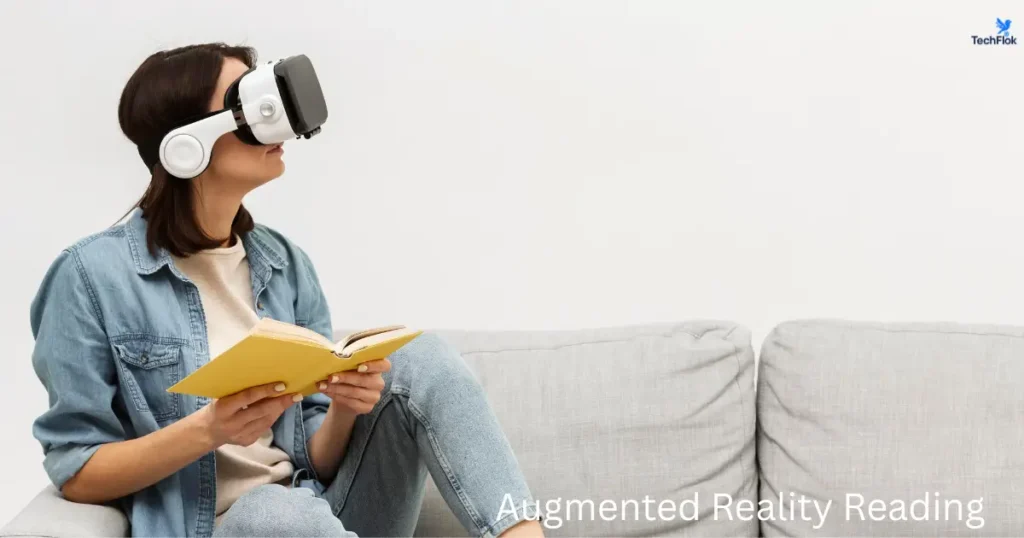
Augmented Reality Reading is a remarkable innovation that combines real-world reading with the digital world. There is a moment every parent remembers. Their child picks up a book, flips through a few pages, puts it down, and reaches for a tablet instead.
It is not that children stopped loving stories. They still do. But the way stories reach them has changed. The world around them moves, glows, makes sounds, and responds to touch. A flat page, by comparison, feels silent.
This is exactly the problem that augmented reality reading is beginning to solve.
Augmented reality reading is not a gimmick or a science fiction idea. It is happening right now, in classrooms, libraries, and living rooms around the world. Children are holding their phones over pages and watching characters walk right out of the paper. Students are pointing their iPads at anatomy diagrams and seeing a human heart beat in 3D on the desk in front of them. Readers in Singapore are wearing AR glasses and feeling the sounds of a story wrap around them as they read each sentence.
This article covers everything you need to know about AR books. What they are, why they matter, what the research actually shows, who is building them, and what the future looks like for everyone who loves reading.
What Is Augmented Reality Reading?
Augmented reality reading is the experience of reading a traditional print book while using a digital device such as a smartphone, tablet, or AR glasses to unlock extra content that appears on the screen.
Think of it like this. You open a children’s picture book about a farm. The illustrations are beautiful, but still. You pick up your phone, open an app, and point the camera at the page. Suddenly, the animals are moving. The cow swings its tail. The rooster crows. The barn door swings open. The image on the page has come to life on your screen, while the paper page sits there beneath it just as it always was.
That layering of the digital world on top of the real world is what augmented reality means. When used with books, the result is an immersive reading experience unlike anything that has existed before.
AR books look exactly like any other paper book. You can flip through them, read the words, and enjoy the pictures the same way you always would. But hidden inside each page is a trigger, a visual marker that the camera on your device can recognize. When it does, the app pulls up a 3D animation, a video, a sound effect, a quiz, or a spoken narration that adds a whole new layer to the story or the lesson.
How Does Augmented Reality Reading Work?
The process is simpler than most people expect.
You open an AR book. You read the page. When you reach a section with an AR feature, you pick up your phone or tablet and point the camera at the area. The app recognizes the image on the page, which acts as the AR trigger, and immediately displays a virtual object or animation on your screen, placed right on top of the real page in front of you.
In newer AR reading experiences, like the one being tested at the Singapore National Library through a partnership with Snap and creative agency LePub Singapore, there are no apps to download at all. Readers wear Snap Spectacles, AR glasses powered by Snap OS, and as they read, the glasses scan the text using text recognition and machine learning. Audio effects, soundscapes, and visuals are triggered automatically in real time to match whatever is happening in the story. A creaking door sounds when a character opens one. A storm builds when the plot calls for it.
Most AR books today work through a mobile app. Some newer platforms, especially WebAR tools, work directly through a browser. You scan a QR code printed in the book, the browser opens, and the AR experience starts with zero downloads needed.
Types of AR Reading Materials

Not all AR books are the same. The technology has spread across several different categories of reading, and each one uses it in a different way. Here is a look at the main types available today.
AR Storybooks for Kids
AR storybooks are the most common type for young readers. They look exactly like a regular storybook but have AR markers on certain pages. When a child points a phone or tablet at those pages, the characters and scenes from the story appear as 3D animations on the screen.
In some AR storybooks, the characters speak their own lines. In others, there are interactive elements where the child can tap to change what happens next. Ukrainian folk tales, classic fairy stories, and original adventure books have all been created in AR storybook format. The AR Reads app is one of the best-known tools in this space, offering a library of AR storybooks for children that work through a single app.
What makes AR storybooks special for young children is that the story still has to be read to unlock what the AR shows. The technology rewards reading rather than replacing it.
AR Textbooks for Students
AR textbooks bring educational content to life in ways that flat diagrams and printed photographs simply cannot. A student studying anatomy can point their phone at a diagram of the heart and watch it beat. A physics student can see the solar system orbit in real time above their textbook page. A chemistry student can rotate a 3D molecular structure to understand how the bonds connect.
Augmented reality textbooks are particularly powerful in STEM education. Several publishers in Scandinavia and the UK have already launched AR versions of science, nature, and anatomy textbooks for university and secondary school students. The feedback from both students and educators has been consistently positive, with teachers noting that students who previously struggled to visualize complex concepts began to understand them much faster once they could see them in 3D.
AR textbooks are also being developed for medical students. AR anatomy apps that work alongside printed textbooks give students the ability to explore organs, systems, and structures in a level of detail that no printed illustration can match.
AR Picture Books and Coloring Books
AR picture books sit between storybooks and art tools. The child reads the book and sees the printed illustrations, but when they scan the page, those illustrations animate and sometimes speak. A forest scene fills with the sounds of birds and rustling leaves. An animal lifts its head and blinks. A character from the story turns toward the reader and waves.
AR coloring books take this one step further. A child colors a page using their own crayons or pencils, then scans it with an app. The colored drawing they just created appears as a moving animated character on screen, with their own color choices applied to it. This combination of physical creativity and digital reward is one of the most genuinely joyful experiences AR has produced for young children.
What Does the Research Actually Say About AR Books?
This is the question that matters most to parents and educators, and the research answers it clearly.
A study by Danaei et al. (2020), published in Computers and Education, looked at children aged 7 to 9 who read the same storybook in two different ways. One group read a regular paper book. The other group read the same story as an AR book with 3D animations and interactive features. After reading, both groups were tested.
The group that used the AR book performed better when asked to retell the story to someone who had never read it. They also performed better on questions that required deeper thinking, the kind where the answer is not written directly in the book but must be understood from context and feeling.
For straightforward detail recall, both groups performed equally. This is an important finding. AR did not replace the reading. It deepened the understanding.
A more recent study by Alhamad, Manches, and McGeown (2024), published in Frontiers for Young Minds, studied children aged 8 to 10 with different levels of reading interest, experience, and ability. The researchers found that AR books changed how children engaged with reading across four specific areas.
The first is behavioral engagement, which covers how much time children spend reading and how they approach the page. The second is cognitive engagement, which is the mental effort they put into making sense of the text. The third is affective engagement, which covers the feelings and emotions they experience while reading. The fourth is social engagement, which is how much they share, discuss, and interact with others around the book.
One boy aged 8 told the researchers that the 3D images helped him understand things better because he could see what was actually happening, not just read words about it.
A girl aged 9 said she enjoyed how the music in the AR book made her feel part of the story.
McGeown and Smith (2024), whose reading engagement framework informed the Alhamad et al. study, have written that reading engagement matters enormously for children’s long-term relationship with books. AR books, when designed well, appear to strengthen all four dimensions of that engagement at once.
Not every child responded positively. Some said AR did not leave room for their own imagination. Some called it a bit of a waste of time. These honest responses matter because they remind us that AR books are a tool, not a magic answer. They work brilliantly for some learners and some types of content. They are not meant to replace the quiet joy of reading a page in silence.
The Real Benefits of AR in Reading and Education

The benefits of AR in reading are specific and worth understanding properly.
Understanding complex ideas becomes easier. There are concepts that words and flat pictures simply cannot convey well. How the solar system moves. What a beating heart looks like from the inside. How a molecular structure connects. How blood flows through the body. For all of these, a 3D model that the student can rotate and explore from every angle teaches far more than a paragraph ever could. This is why augmented reality in education is gaining ground so quickly in STEM subjects, including chemistry, physics, anatomy, and biology.
Students feel more motivated to learn. Engagement and motivation are two of the biggest challenges teachers face every day. Educators who have used AR books in classrooms consistently report that students are more excited to open the book, more willing to keep reading, and more likely to remember what they covered.
Reading becomes a shared experience. One of the quieter benefits that researchers noticed is that AR books encourage children to read together. They naturally want to share what they are seeing on the screen. They take turns pointing the camera. They laugh together. They explain things to each other. This kind of social reading behavior is something that solo screen time rarely produces.
It helps children who struggle with reading. AR books can include audio narration, visual cues, and animated explanations that support different learning styles. For a child who finds reading difficult or who is not yet fully fluent, having a voice reading alongside them or an image moving to match the words can make the text feel less frightening. This is what makes augmented reality reading a genuine step toward more equitable education.
Libraries stay relevant. Public libraries around the world are adopting augmented reality to attract younger visitors and make their collections more engaging. Augmented reality in libraries allows institutions to bring historic texts and ancient manuscripts to life, create location-based AR experiences where visitors unlock stories by moving through the building, and run AR reading events that turn a quiet Saturday afternoon into something memorable.
What Parents Think About AR Books
In one study, 47 parents read an AR book with their child for around 20 to 30 minutes and then shared their thoughts with researchers. Most of them, 35 out of 47, loved how real the 3D images felt. They were also surprised that the experience worked through ordinary phones and tablets with no special equipment required.
But not all parents were enthusiastic. Only 16 out of 47 felt confident that AR books would help their child understand and remember what they had read. And 12 parents worried that the technology might distract their children from actually reading.
These concerns are fair. The distraction risk is real when an AR feature is designed purely for entertainment with no connection to the words on the page. But when AR is designed as a tool to explain and deepen the text rather than compete with it, the research shows it genuinely supports learning.
The key point, as educators and AR book creators have consistently noted, is that AR should not be used just for the sake of using AR. When a concept can be better shown in 3D, or when a learner needs more than a flat image to understand what is happening, that is where AR adds real value. Used that way, it is not a distraction. It is a window.
The Challenges of AR in Education Today
The honest reason why AR books are not yet in every classroom is that creating them has traditionally been too expensive and too technically complicated.
Until recently, building AR experiences required programmers, 3D designers, and serious budgets. This meant that the people who understood the content best, the teachers, authors, and subject specialists, were left out of the process entirely. Technology companies that could build AR often did not have the educational expertise to make it meaningful. The result was AR that looked impressive but taught little.
This is changing quickly.
Platforms like Ludenso, ARLOOPA Studio, and Kivicube have been built specifically to close that gap. They allow anyone, including librarians, teachers, and book authors with no coding experience, to create AR reading experiences from scratch. These no-code AR creation tools let you upload a 3D model or video, position it over the page image, and publish it. The whole process can take minutes.
When the people with the knowledge can build the experience themselves, the quality of AR content improves enormously. And when the barrier to creation falls, the number of AR books in the world grows rapidly.
Tools for Creating AR Books: What Publishers and Creators Are Using
For anyone who wants to create an AR book, there are several strong options available right now.
Ludenso is a platform built for editors and textbook authors. Developed in Scandinavia, it has been used to create AR versions of nature, science, and anatomy textbooks. The drag-and-drop interface allows non-technical users to attach 3D content to specific pages and publish it through the Ludenso AR platform. Publishers in the UK have used it to create AR STEM textbooks for chemistry and physics courses.
ARLOOPA Studio is a tool that libraries, schools, and publishers use to create interactive AR books and cultural experiences. It supports 3D models, GIFs, videos, and sounds. Libraries can create location-based AR experiences tied to specific sections of their building. It is built for users with no programming background and has been adopted by institutions around the world looking to make collections more engaging.
Kivicube is a WebAR platform that allows creators to build AR book experiences that work directly in a browser with no app download needed. Readers scan a QR code printed in the book, and the content opens instantly. Kivicube provides over 100,000 3D models and more than 200 industry templates, making it genuinely accessible to first-time creators. It has been used to create AR children’s picture books, science books, and AR art books.
Each platform follows the same basic process. First, prepare your content by deciding which pages to enhance and gathering the digital assets you want to use, such as videos, 3D models, or audio clips. Second, build your AR scene using the platform’s visual editor. Third, publish and distribute through an app or a QR code printed inside the book.
Augmented Reading: The Next Level
While most AR books rely on a phone or tablet, a new and more immersive category is beginning to emerge.
In 2025, the Singapore National Library Board, working with Snap and creative agency LePub Singapore, introduced what they called an Augmented Reading experience. Readers wearing Snap Spectacles, AR glasses powered by Snap OS, could read any physical book while the glasses added a real-time audiovisual layer to the experience.
The technology works by scanning the text as it is being read. Using text recognition and machine learning, it identifies the story content and triggers matching audio and visual effects. A suspenseful scene brings a low, rising sound. A forest setting fills the reader’s ears with birdsong and rustling leaves. Virtual objects collected during the reading session can be shared with others.
LePub’s Executive Creative Director Stephan Schwarz explained the goal simply. The aim is not to replace traditional reading but to create a compelling gateway to books. Once readers are drawn into the story, the hope is that they keep reading to find out what happens next.
This experience is still in beta testing and is expected to be available for public trial through selected Singapore libraries. But it represents the clearest picture yet of where augmented reality reading is heading. A world where books and technology work together rather than competing for attention.
AR Books for Reluctant Readers: A Gap Worth Filling
One audience that has not been fully served by the current range of AR books is the reluctant reader.
Many children struggle with reading, not because they lack ability but because reading has never felt exciting enough to compete with everything else around them. For these children, an AR book can make a genuine difference.
When a reluctant reader opens an AR book, and something moves, sounds, or responds to them, their relationship with the page changes. Reading stops feeling like a task and starts feeling like a discovery. Pointing a phone at a page feels active and modern. The reward of seeing the animation appears immediately. And to get that reward, the child still has to engage with the words on the page.
This is why AR books for reluctant readers deserve far more attention from publishers, educators, and parents. The technology exists. The research supports it. The gap simply needs to be filled with books that are designed with this audience specifically in mind.
AR Books as Gifts: A Growing Market
There is a practical angle that many parents are just beginning to discover.
Augmented reality picture books make genuinely memorable gifts for children. They are physical objects that can be wrapped and presented. But they carry an experience that purely digital gifts cannot match. A child who receives an AR picture book gets the warmth of a real book and the wonder of watching it come to life the moment they open it.
As more publishers enter this space, the range of AR books available for birthdays, holidays, and special occasions is growing steadily. Science books that animate space exploration. Folk tale collections where traditional characters perform their own stories. History books where maps move, and events unfold in 3D. These are not just books. They are experiences wrapped in paper.
The Future of AR in Libraries
Libraries have always been places of discovery. AR is not changing that. It is making discovery more powerful.
Libraries that embrace augmented reality in libraries can create experiences that go far beyond their printed collections. They can take historic photographs and trigger archival video footage connected to them. They can display 3D models of ancient artifacts that would otherwise be too fragile to handle. They can run AR reading events where children complete story quests by exploring different parts of the building.
Most importantly, AR helps libraries stay meaningful in a world where young people have more options for their time than ever before. When a library becomes a place where the books move, and the walls tell stories, it becomes somewhere worth visiting again and again.
The future of libraries is not only about storing knowledge. It is about creating immersive learning environments where knowledge is not just read but also experienced with all the senses.
What the Future of AR Publishing Looks Like
The publishing industry is at a genuine turning point.
For centuries, a book was a fixed object. Once printed, the text could not change, the images could not move, and the experience was the same for every reader. AR publishing is beginning to change all of that.
Publishers who embrace AR books now are not just adding a feature to their catalogue. They are redefining what a book can be. A single printed page can now hold more information than an entire chapter once carried. A science book can show the same concept from multiple angles to serve different learning styles. A children’s story can perform itself in front of the child reading it.
No-code platforms have removed the technical barrier entirely. Tools like Kivicube, ARLOOPA Studio, and Ludenso mean that an author, editor, teacher, or librarian can create a full AR book experience without writing a single line of code. The process is now as simple as uploading an image and adding a video or 3D model above it.
The cost barrier is falling, too. WebAR removes the need for app development completely. A QR code printed inside a book is all that is needed to deliver a rich AR reading experience to any reader anywhere in the world.
Within the next few years, augmented reality reading will not be an exceptional feature. It will be an expected one.
How to Start Reading AR Books Today
For parents and educators who want to explore AR books right now, the process is straightforward.
Many AR books are already available in physical bookstores and online retailers. They are usually labeled with AR branding or include a note inside the cover explaining which app to use. Some of the most popular examples include interactive science books that display the human body in 3D, nature encyclopedias where animals come alive when scanned, and children’s picture books where the illustrations begin to move and speak.
For those who want to create an AR book experience, free trials are available on platforms like Kivicube and ARLOOPA Studio. Both allow first-time users to build a simple AR scene within minutes.
For anyone who wants to experience AR reading before buying a book, several publishers offer sample AR experiences through their apps. These are worth trying simply to understand what is now possible.
Conclusion
Reading has always been one of the most human things we do. It is how we learn, how we travel to worlds we have never seen, and how we feel things we have never experienced. Books have survived every technological shift in history because what they do at their core is irreplaceable.
Augmented reality reading does not threaten that. It honors it.
By adding movement, sound, 3D depth, and real interaction to the pages we already love, AR books make reading more accessible, more engaging, and more powerful for more kinds of people. For the child who struggles to stay with a flat page, for the nursing student who needs to see the organ not just read its name, for the library that wants to give young visitors a reason to come back, and for the publisher who wants their books to live beyond the shelf, AR reading offers something genuinely worth having.
The technology is no longer experimental. The research backs it. The tools are available to anyone who wants to use them. The only question left is how quickly we choose to embrace it.
And the answer, if you watch the children holding their phones over pages and seeing stories come alive in front of them, is that the choice has already been made.
FAQs
What are augmented reality books?
Augmented reality books are traditional printed books that work alongside a digital device like a smartphone or tablet. When you point the device camera at a marked page, the app overlays 3D animations, sounds, videos, or interactive elements onto the page on your screen. The physical book stays the same. The digital layer adds a whole new dimension to it.
What are the best AR storybooks for children?
Some of the most popular AR storybooks for children include titles available through the AR Reads app, which offers a full library of interactive storybooks where characters animate when scanned. ARLOOPA Studio has also published AR storybook collections. For coloring and picture book experiences, QuiverVision is one of the most widely used apps for younger children, turning colored pages into animated characters on screen.
Are AR textbooks available for students?
Yes, AR textbooks are available and growing rapidly in number. Publishers in Scandinavia and the UK have launched AR textbooks for STEM subjects, including chemistry, physics, anatomy, and biology. The Ludenso platform has been specifically used to produce AR textbooks for nursing and science students. For medical students, AR anatomy apps that work alongside printed textbooks are also widely available and allow students to explore the human body in 3D detail.
What is augmented reality reading?
Augmented reality reading is the experience of reading a physical book while using a digital device to access extra content that appears on screen when the camera is pointed at the page. This content can include 3D animations, audio effects, videos, quizzes, or spoken narration that adds depth and interactivity to the reading experience.
Do AR books improve reading comprehension?
Research says yes, with some important details. Danaei et al. (2020) found that children reading AR books performed better at retelling stories and answering deep thinking questions compared to children reading the same book in print. For straightforward detail recall, both groups performed equally. This suggests AR deepens understanding rather than simply replacing it.
Are AR books good for children?
Most research and educator feedback says yes, particularly for children who are visual learners or who struggle with reading motivation. The Alhamad et al. (2024) study found that AR books positively affected all four dimensions of reading engagement: behavioral, cognitive, affective, and social. However, some children prefer to use their own imagination, so AR books work best when used alongside traditional books rather than replacing them entirely.
Can AR books distract children from reading?
This is a fair concern that some parents have raised in research settings. The distraction risk is highest when AR features are designed purely for entertainment with no connection to the text. When AR is meaningfully connected to what is on the page, the research shows it supports reading rather than competing with it.
What are the benefits of AR in education?
AR in education improves understanding of complex concepts, increases student motivation, supports different learning styles, makes abstract ideas visible in 3D, and encourages social and collaborative learning. It is particularly effective in STEM education, where diagrams and flat images often fail to capture the full complexity of the subject.
How do I create an AR book without coding?
Platforms like Kivicube, ARLOOPA Studio, and Ludenso all allow anyone to create AR books without coding. You upload your digital assets, such as a 3D model or video, position them over the relevant page image using a visual editor, and publish via a QR code or app link. The process can be completed in minutes.
What is WebAR for books?
WebAR is augmented reality that works directly in a web browser with no app download needed. Readers scan a QR code printed inside the book, and the AR experience opens instantly in their phone browser. Kivicube is one of the most widely used WebAR platforms for book creators.
Where can I buy AR books?
AR books are available in physical bookstores, online retailers, including Amazon, and directly from publishers. They are usually marked with AR branding on the cover or include app instructions on the inside cover. Many AR book apps also have in-app libraries where additional titles can be purchased or downloaded.